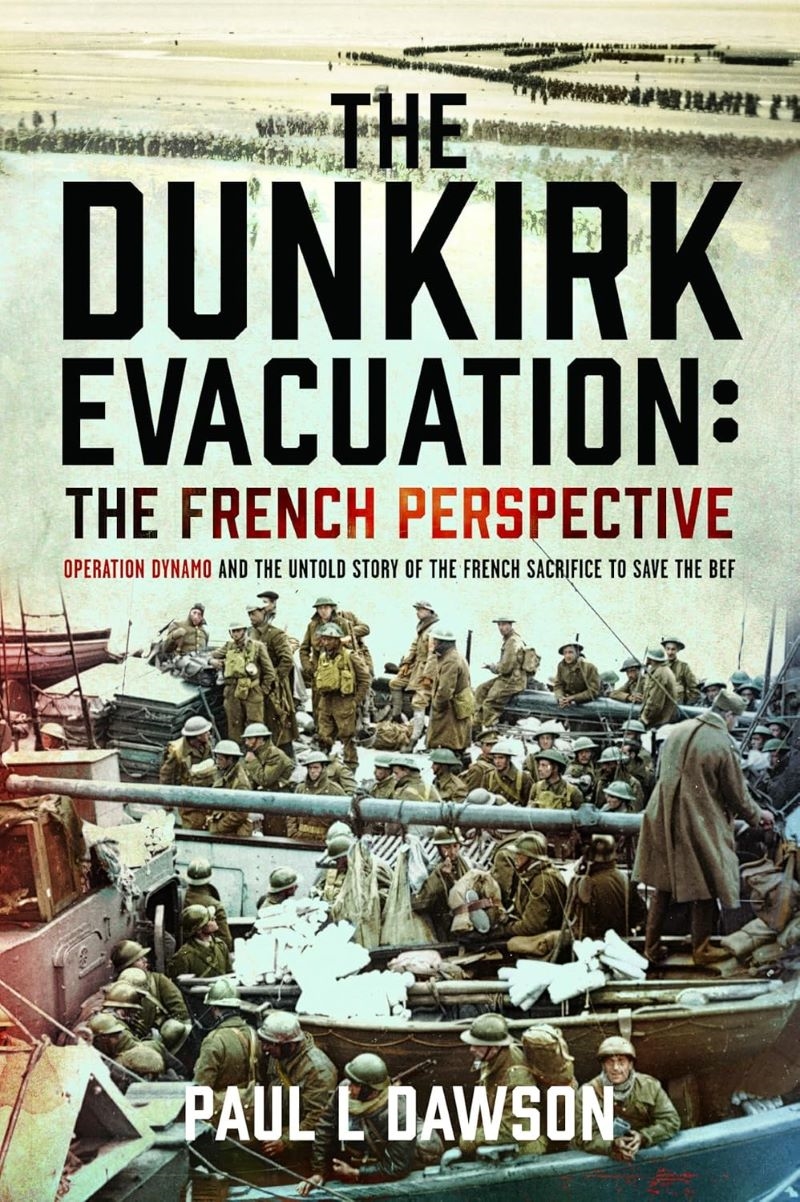
Hitler unleashed his Blitzkrieg in the West on 10 May 1940. As German troops advanced, the British Expeditionary Force, the French First Army and the Belgian Army found themselves squeezed into a narrow corridor between Lille and Dunkirk. By 24 May, there were 400,000 soldiers trapped there, with only one chance of survival to be evacuated. Somehow, the beleaguered Allied troops had to hold off the might of the German forces long enough for the bulk of the British, French and Belgian soldiers to be saved. Day after day the Germans attacked the defensive perimeter, but the defenders hung on. 'Even in defeat', wrote a German commander on 29 May, 'the French fight like lions the BEF is in complete disintegration. It has simply deserted all its vehicles and equipment and is fleeing to the sea.' As the troops were lifted from the beaches and Dunkirk harbour, fewer and fewer men were left to defend the thinning and shrinking perimeter, one whole sector of which was manned by French troops. Finally, as the last ship departed from Dunkirk on 4 June, around 40,000 French troops were all that remained holding the line. Finally, at 08.00 hours on 4 June, German troops reached the French naval headquarters in Dunkirk. It was there that General Barthélemy formally surrendered. 'No episode in the epic of Dunkirk,' wrote the French historian of the battle, 'caused more heartbreak', as the brave defenders of Dunkirk marched into captivity. Their sacrifice was noted by Churchill, who recognised that, 'These troops thus made a splendid contribution to the safety of their more favoured comrades and the British Expeditionary Force.' Using archival sources in France and Belgium, much of which has not been previously published in English, Paul Dawson throws fresh light on a little-known aspect of one of the most famous episodes of the Second World War. Had it not been for the sacrifices of the French troops, Britain's situation in the summer of 1940, as Hitler's forces bore down on the Channel coast, might have been far more precarious. AUTHOR: Paul L. Dawson BSc Hons M. Res MIFA FINS has had a lifelong passion for archaeology and history, holding both a degree in archaeology, and a master's degree in history. Over the last twenty-five years he has written almost fifty books, primarily on the period 1660 to 1831, exploring the relationship between political and religious dissent with the state, equine nutrition and biomechanics, as well as the history of his home city of Wakefield in West Yorkshire. Perhaps he is best known for his series of ground-breaking books on the Waterloo Campaign of 1815 and his studies of the uniforms and equipment of the French army 1792-1815. Outside of writing and research, he is a gifted equestrian, riding for film and TV, as well as competing dressage and teaching classical equitation. In his free time, he is a church musician both organist, choir director and solo singer and lay minister with the General Assembly of Unitarians and Free Christians. Following a severe traumatic brain injury, resulting in speech, cognition and some mobility issues, he is a campaigner for disability rights for others recovering from brain injury. 16 b/w illustrations
Title: Dunkirk Evacuation: The French Perspective: Operation Dynamo and the Untold Story of the French Sacr
Format: Hardback Book
Release Date: 01 Oct 2026
Author: Paul L. Dawson
Sku: 3674230
Catalogue No: 9781036133801
Category: History




 Sign In / Register