In Stock at Supplier. Ships within 5-10 Business Days.
1521 ELITE Points earned with this purchase! Earn 250 for a $10 Reward!
Not an ELITE Member? Join ELITE here
Buy Now & Pay Later With


Modernism, whether seen as a period designation, a manifestation of formal experimentation, or an aspect of modernity, has since its inception been marked, consciously or unconsciously, by gender. The dates 1890-1940, typically accepted as encompassing the modernist period, coincide with the first wave of feminism and its educational, suffragist, socialist, and professional agendas. Feminist activism and ideology of the period, as well as reactions against them, made gender a field of contention, sometimes labelled the "sex wars." The long shadow left by the Oscar Wilde trials, and the flourishing of gay and lesbian cultures, particularly in the urban centres of modernism in the teens and twenties, also queered normative notions of masculinity and femininity. In response to global consumer culture, diverse images of the modern girl emerged, also putting conventional notions of gender to the test. The Harlem Renaissance had its own gendered politics and expressions, as did modernism’s venturing into and emergence from colonial situations around the globe.
The discussion of gender in modernism arose in the 1970s, along with the second wave of feminism and the introduction of feminist theory and criticism to the academy. It challenged the ways that the modernist canon, and the experimental forms associated with modernism, had been fashioned as normatively male. Early on, various approaches to the exploration of gender were available, including the gendering of style available in French Feminist theory, psychoanalytic approaches, materialist feminism, and gyno-critical attention to women writers. Raising questions of gender concerning modernist texts had become an expectation by the 1990s. Debates about the adequacy of gender as the central concern of feminist theory have led to the useful concept of intersectionality, which heeds the ways that other social categories, such as race, class, sexuality, dis/ability, and global/colonial location, intersect with gender in creating the standpoint of an individual. Equally valuable are challenges to binary divisions encouraged by gendered oppositions, and the study of ways that gender is produced by culture or performed.
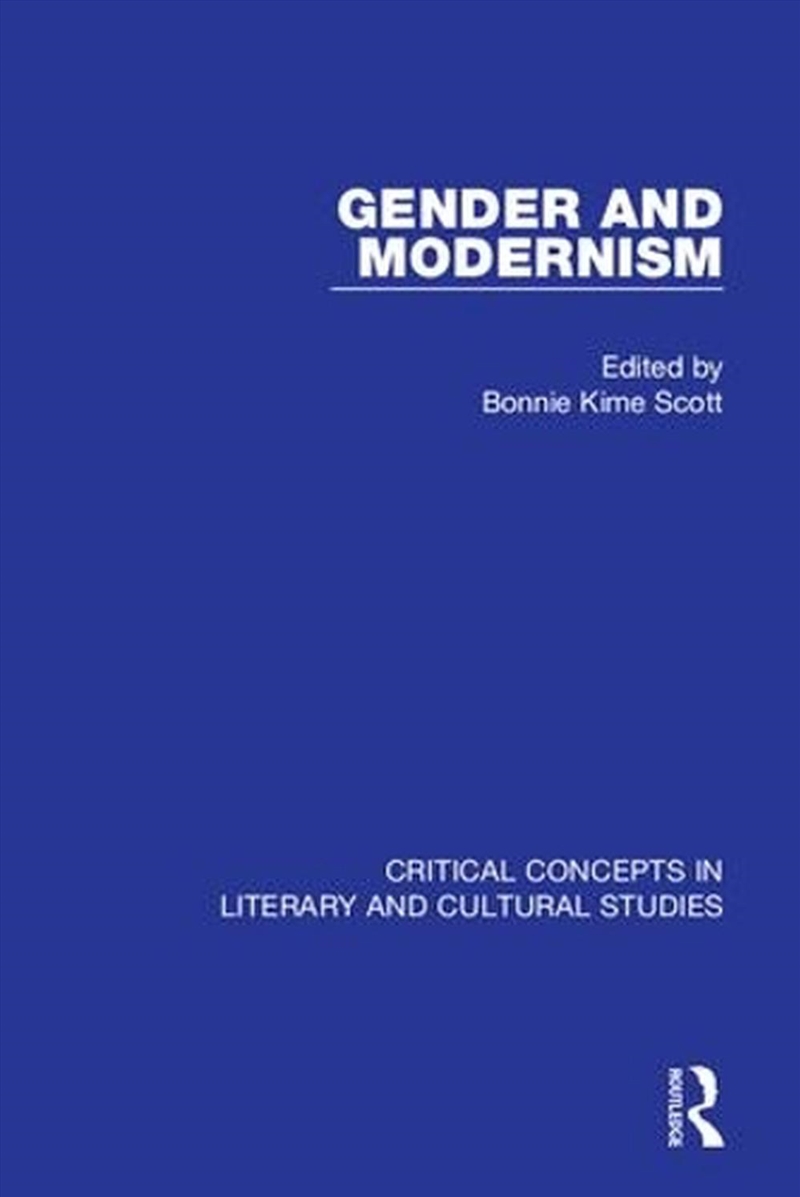
Title: Gender and Modernism: Critical Concepts 4 vols
Format: Hardback Book
Release Date: 19 Mar 2008
Author: Bonnie Kime Scott
Sku: 3645250
Catalogue No: 9780415380928
Category: Literature & Poetry

 |
Help you find exactly what you are looking for, even if you aren't sure yourself! |
|
Track down the hard to find as quickly as possible - if it's available, we will get it! |
|
Deliver fast and friendly service to every customer. |
|
Provide you with the hottest, the latest and a great range. |
|
And if you're not satisified, you can exchange or with a receipt, get your money back - no questions asked! |
 Sign In / Register