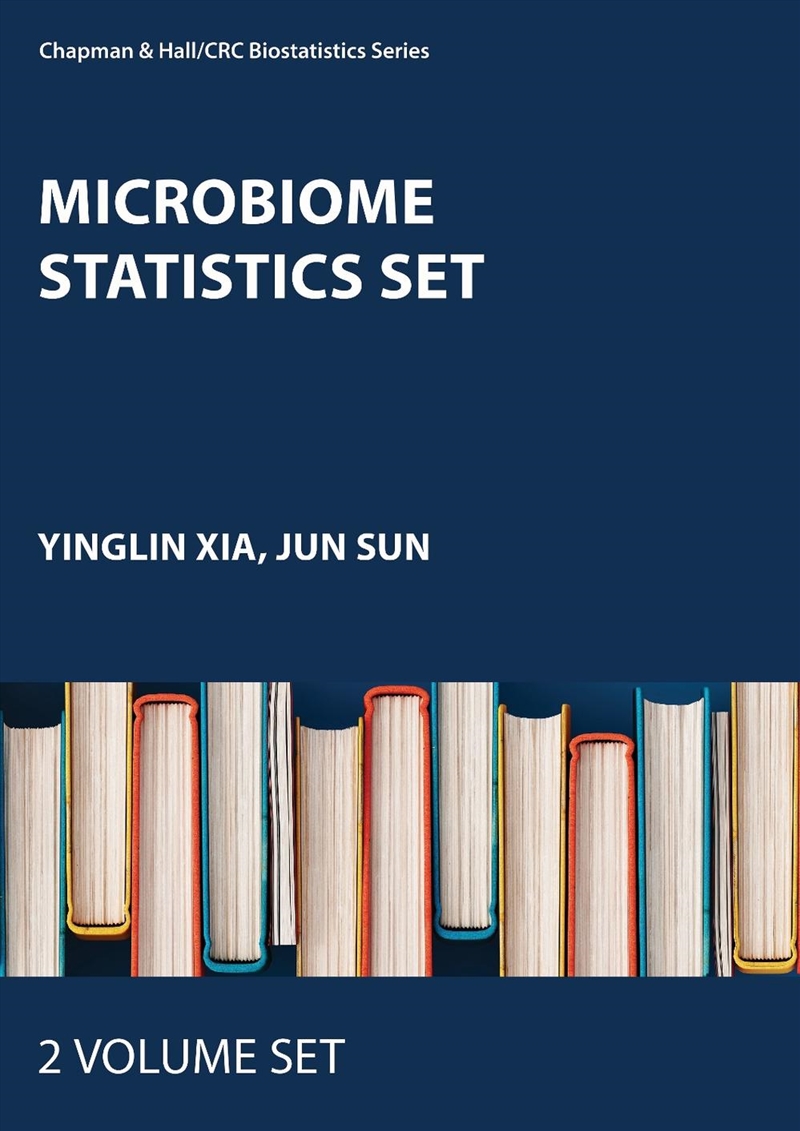
Microbiome Statistics Set by Yinglin Xia is a Maths title available in books format. Microbiome Statistics Set addresses the statistical analysis of correlation, association, interaction, and composition in microbiome research and talks about the challenges of machine learning statistics with an emphasis on the importance of performance valuation by appropriate metrics and independent data. The books define the study of the microbiome as a hypothesis-driven experimental science and investigate challenges for statistical analysis of microbiome data using the standard statistical methods while also providing the step-by-step procedures to perform machine learning microbiome data, including feature engineering, algorithm selection and optimization, performance evaluation and model testing. They comment on the benefits and limitations of using machine learning for microbiome statistics and remarks on the advantages and disadvantages of each machine learning algorithm. This set consists of 15 chapters on applied microbiome statistics and 19 chapters on machine learning for microbiome statistics and is an excellent reference for researchers, students, academics and data analysts in the field. Key Features: · Discusses the issues of statistical analysis of microbiome data: high dimensionality, compositionality, sparsity, overdispersion, zero-inflation, and heterogeneity. · Describes important concepts of machine learning, including bias and variance tradeoff, accuracy and precision, overfitting and underfitting, model complexity and interpretability, and feature engineering. · Investigates statistical methods on multiple comparisons and multiple hypothesis testing and applications to microbiome data. · Introduces a series of exploratory tools to visualize composition and correlation of microbial taxa by barplot, heatmap, and correlation plot. · Introduces confusion matrix and its derived measures. Comprehensively describes the properties of F1, Matthews' correlation coefficient (MCC), area under the receiver operating characteristic curve (AUC-ROC), and area under the precision-recall curve (AUC-PR), as well as discusses their advantages and disadvantages when using for microbiome data. · Employs the Kruskal-Wallis rank-sum test to perform model selection for further multi-omics data integration. · Offers all related R codes and the datasets from the authors' first-hand microbiome research and publicly available data.
Title: Microbiome Statistics Set
Format: Books
Release Date: 26 Feb 2026
Author: Yinglin Xia
Sku: 3528007
Catalogue No: 9781041220138
Category: Maths




 Sign In / Register