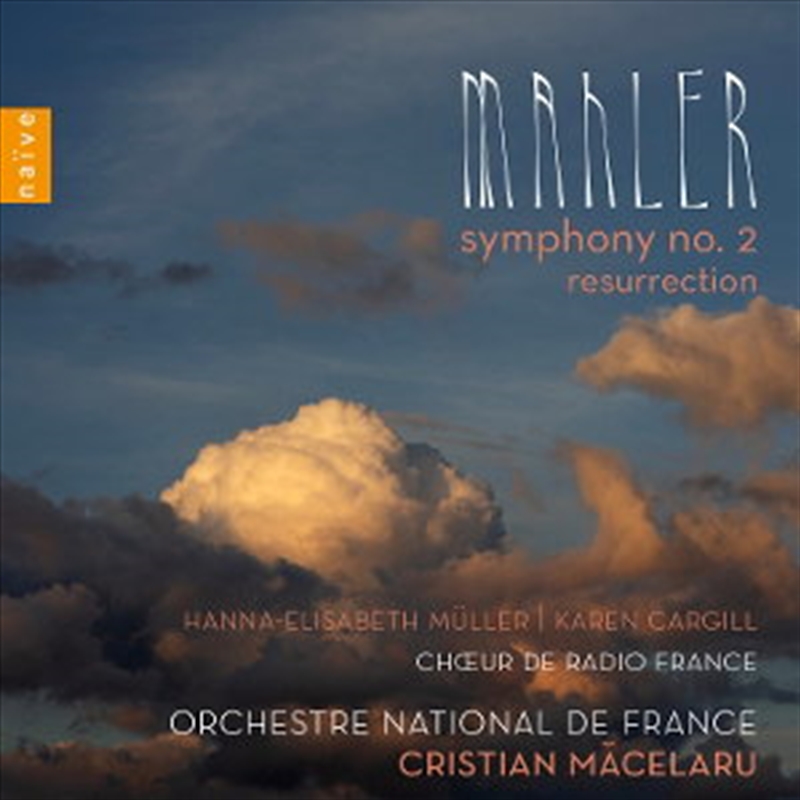
(summary)
In October 2024, the Orchestre National de France under the baton of music director Cristian Macelaru,
immersed itself in one of the great symphonic works of Gustav Mahler (1860-1911): his extraordinary
Resurrection Symphony. On this new recording, the epic journey unfolds serenely, bathed in warm pastoral
colours.
(complete blurb)
Over two evenings on 24 and 25 October 2024, the Orchestre National de France under it's music director
Cristian Macelaru immersed themselves in the extraordinary symphonic epic that Gustav Mahler wrote in
the 1890s: his utterly unrestrained Symphony No. 2, the Resurrection. What a baptism of fire! The Romanian
conductor, not known for his Mahler until now, boldly takes up, in Paris, the very same score that the
legendary Leonard Bernstein conducted at his first great Parisian triumph on 13 November 1958-which as it
happens was also with the Orchestre National.
More than 70 years after Bernstein, Cristian Macelaru offers a vision that is the complete opposite, with a
chamber-like approach of delicacy and pastoral warmth, in contrast to his illustrious predecessor's
grandiose and solemn take. The textures are therefore amazingly light: the magnificent transparency of the
strings is answered by woodwinds brimming with freshness, discreetly revealing the roots of a composer
born not far from Prague who was passionately drawn to new sonorities and unexpected instrumental
blends. Under the Romanian conductor's direction, joined here by the luminous soprano of Hanna-Elisabeth
Muller and the amber-toned mezzo of Karen Cargill, the passionate journey of Resurrection becomes one of
profound serenity. The architecture of the work remains consistently natural and supple, and the symphony
finds it's unity effortlessly despite the remarkable diversity of soundscapes of which it is made.
It was in 1888 that Gustav Mahler first conceived the large-scale symphonic piece he called Todtenfeier
(Funeral Rites), in which he portrays, from the height of a steep promontory, the entire life of the hero of his
First Symphony, the Titan. Slightly revised, this became the introductory Allegro maestoso of the Second
Symphony, to which Mahler later added four more movements. The second takes the form of a shimmering
Landler, deceptively gracious, with interwoven motifs. The third is a scherzo based on his song Des
Antonius von Padua Fischpredigt ('St. Anthony of Padua preaching to the fishes', No. 6 from Des Knaben
Wunderhorn). For the fourth movement, the composer draws on another song from Des Knaben
Wunderhorn, No. 12, Urlicht ('Primeval Light'), preserving the vocal line while altering some of the
orchestration and harmonic progressions. Gustav Mahler searched a long time for inspiration for the Finale,
finding it eventually while listening to a choir sing a hymn during the funeral of the great conductor Hans von
Bulow. The hymn was based on words by the poet Friedrich Gottlieb Klopstock, and Mahler resolved then
and there to conclude his work with this hymn to resurrection, supplementing Klopstock's text with several
verses of his own. Overall, then, Gustav Mahler's Symphony No. 2 opens with a meditation on death, and
moves steadily through earthly life in all it's tenderness and irony to a proclamation of faith in the
resurrection-the sole subject of the Finale-in which soloists, chorus and orchestra come together in a
glorious gesture of reconciliation.
Title: Mahler: Symphony No. 2 "Resurrection"
Format: CD
Release Date: 02 Oct 2026
Artist: Orchestre National De France
Sku: 3715249
Catalogue No: NAV9093.2
Category: Classical




 Sign In / Register