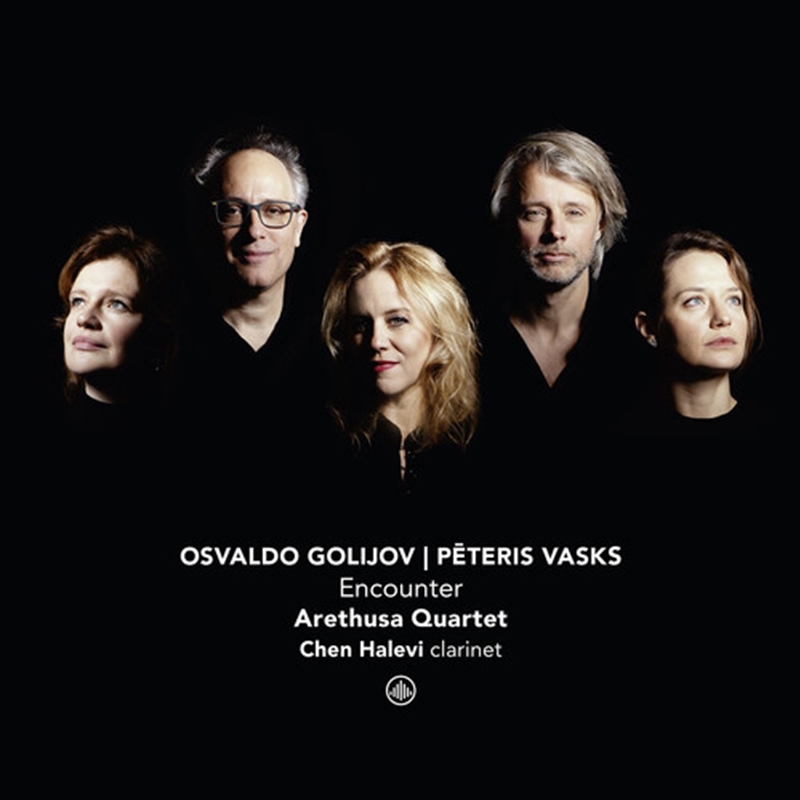
Encounter brings together two towering works of contemporary chamber music that speak across cultures, histories, and inner worlds. Osvaldo Golijov's The Dreams and Prayers of Isaac the Blind and Peteris Vasks' String Quartet No. 6 arise from profoundly different traditions-Jewish mysticism and Baltic spirituality-yet meet in a shared search for truth, memory, and transcendence. Both works are intensely personal, rooted in lived experience and belief, and animated by music's power to give voice to what lies beyond words: longing, suffering, hope, and illumination. In this recording, these worlds do not merely coexist; they listen to, reflect, and transform one another.Performed by the Arethusa Quartet with clarinetist Chen Halevi, Encounter is also a meeting of artistic journeys. Golijov's ecstatic, ritual-like score unfolds as a spiritual ascent through dreams, prayers, and blindness-understood as deeper inner vision-while Vasks' Sixth Quartet traces a life's arc from farewell and remembrance to a final, hushed encounter with transcendence, illuminated by echoes of Beethoven. Across both works, vulnerability and intensity are balanced by stillness and song, darkness by light. What emerges is an album that feels at once intimate and universal: an affirmation of shared humanity, and a reminder of music's enduring ability to connect past and present, earth and spirit, performer and listener.=Curiosa is conceived as a personal "cabinet of curiosities" by violinist Jorge Jiménez, bringing together music that entered his life through years of travel, collaboration, and discovery. The album spans laments, dances, preludes, fugues, and songs from both renowned and anonymous sources, ranging from the Middle Ages to the Baroque and beyond. Each piece is selected for it's emotional depth, strangeness, and expressive power, forming a living repertoire shaped in rehearsals, late-night conversations, concerts, and recording sessions. Central to the project is Jiménez's fascination with unaccompanied music and historical instruments, particularly the baroque violin and vielle, whose raw and earthy sound transports the listener into earlier sound worlds.Throughout Curiosa, Jiménez weaves together personal heritage, musical memory, and imaginative storytelling. His own arrangements connect Bach, Dowland, Strozzi, Gaspar Sanz, and traditional tunes with vivid images. Joined by Joy Smith on early harps and Daniel Garay on historical percussion, and performing with his ensemble Tercia Realidad, Jiménez blends historical insight with spontaneity and improvisation. The result is an album that feels both intimate and expansive-music passed "between hands, ears, and hearts," constantly transforming while remaining deeply rooted in shared curiosity and human connection.Jorge Jiménez: "These pieces entered my life through the extraordinary musicians and ensembles I've been fortunate to work with across Europe. They form a living repertoire shaped in rehearsal rooms, late-night conversations, recording sessions, and concerts."=During the darkest of the lockdowns, I took my daughter to an open field near our home. In a time when the world felt shuttered and small, walking was our only escape from the suffocating stillness. As we reached the field, a sudden sensation washed over me-a quiet awakening. It wasn't just the spring breeze or the scent of the grass; it was a sudden reminder of what being alive meant. I felt I had been touched by Zephyr, the Greek god of the west wind, sparking a renewed wish to create and perform for the world once more.Liberte´: A piece exploring and searching for emotional freedom.Zephyr: Named after the gentle west wind, this track served as the primary source of inspiration for the entire album.Fushigi no Kuni: Translating to "Wonderland" in Japanese, this piece was inspired by Alice's Adventures in Wonderland written by Lewis Carroll.A Troubadour in the Moonlight: A composition and improvisation depicting a minstrel serenading a loved one beneath the moon.For Misato: A heartfelt dedication to Misato-san, my dear friend who departed too young.The five songs above are composed by Yukari.Eurus, Suibokuga, Pandora's Box, Don't Follow the Piper, and Au crépuscule are collective improvisations.="We can imagine some eyebrows being raised at the description of Dora Pejacevic as a contemporary of Brahms; the two composers were born more than fifty years apart, and their lives only overlapped by twelve years. Yet both works by Pejacevic are unmistakably from the same compositional lineage as that by Brahms; and both are works written early on in Pejacevic's remarkable (and, sadly, all-too-short) life. Both pieces belong clearly to the romantic tradition, displaying no hint of the more modernist directions which her later works would take. We were immediately intoxicated by the passionate sweep of Pejacevic's Piano Quartet, but also the tenderness of it's slow movement, and felt it would make the perfect bedfellow for the First Piano Quartet of Brahms, a piece to which Tom has felt particularly close since student days. Brahms's Piano Quartet is justly one of the best-loved of all chamber works, and few works are more exhilarating to perform: the first movement offers an abundance of glorious themes; the second takes us to a mysterious dreamworld; the third luxuriates in expansive lyricism; then the fiery virtuosity of the gypsy finale sends us headlong to the finish line. This album brings us to the end of our recorded journey through Brahms's three piano quartets, and it has been the greatest privilege and joy to record these works, alongside three major piano quartets by composers who deserve to be far better known. However, we are pleased to say that the series does not end here: looking beyond the piano quartets, we have further albums in preparation, pairing Brahms with his brilliant and lesser-played contemporaries."-Kaleidoscope Chamber Collective




 Sign In / Register