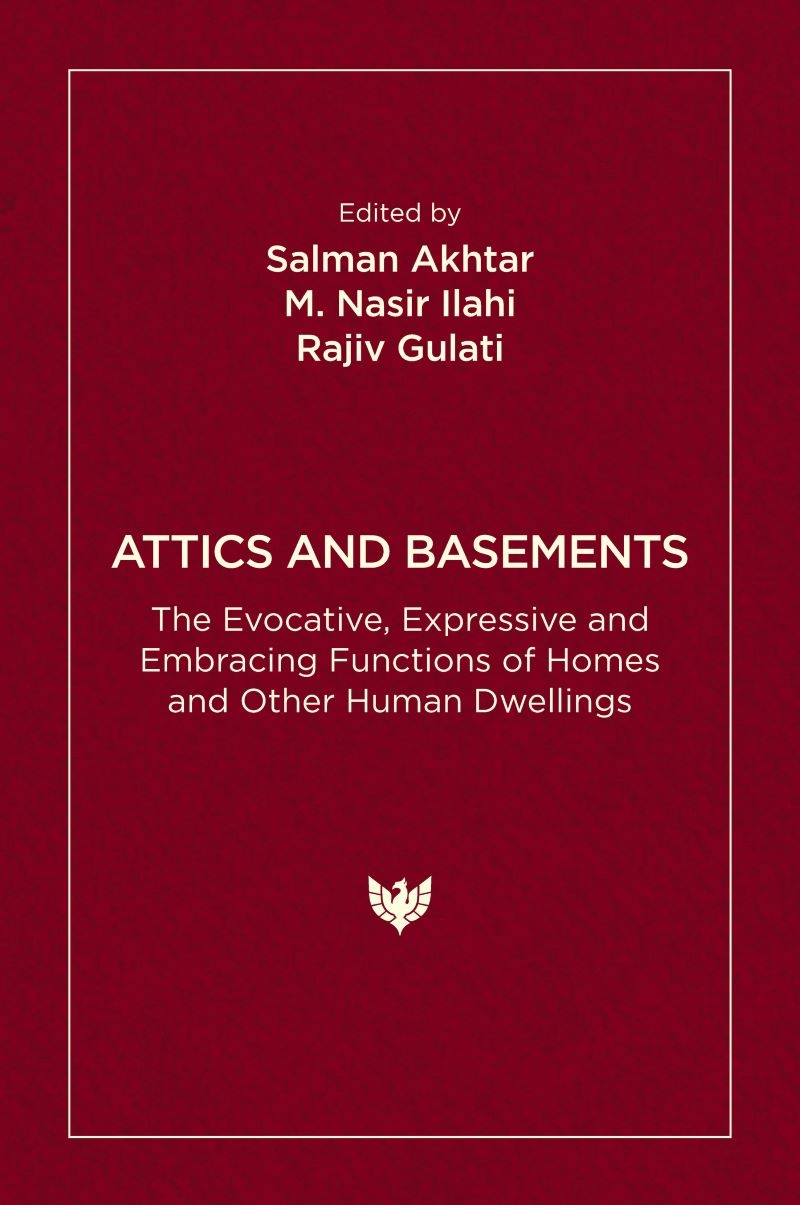
Attics and Basements: The Evocative, Expressive and Embracing Functions of Homes and Other Human Dwe by Salman Akhtar is a Psychology Paperback Book. Our relationship with 'home' includes many psychosomatic realms: perception, imagination, fantasy, projection, separateness, boundaries, smells, and sounds. Our very first home is our mother's womb; our very last, an urn or coffin. In between, we have our childhood home, deeply incorporated into our psyche, which persists, throughout life, as (hopefully) a fond prototype, an object of nostalgia, and a source of ego-replenishment, college dorms, shared housing, apartments, marital and family homes, downsized residences of late middle age, retirement homes, nursing homes, and hospices. Far apart from a world of linear progression are traumatizing homes, foster homes, and orphanages where searingly painful as well as defiantly triumphant scenarios of growth and development may unfold. Also, monasteries, which embody the human desire for detachment, silence, and contemplation, away from earthly relations to seek spirituality and transcendence. The contributions from Aisha Abbasi, Salman Akhtar, Rajiv Gulati, M. Nasir Ilahi, Gurmeet S. Kanwal, Murad Khan, Milan Patel, Sarita Singh, and Nidhi Tewari seek to demonstrate that at each step in the life span, our dwellings both impact upon and reflect our intrapsychic goings-on. As well as examinations of the kinds of home mentioned above, the abstract nature of home is also explored, looking at its function, the search for a sense of home, homesickness, absence, nostalgia, and the development of a stable internalized home. There's no place like home and Attics and Basements shows us why. AUTHOR: Salman Akhtar, MD, is Professor of Psychiatry at Jefferson Medical College and a Training and Supervising Analyst at the Psychoanalytic Center of Philadelphia. He has served on the editorial boards of the International Journal of Psychoanalysis, the Journal of the American Psychoanalytic Association, and the Psychoanalytic Quarterly. His more than 400 publications include 105 books, of which the following 22 are solo-authored: Broken Structures (1992), Quest for Answers (1995), Inner Torment (1999), Immigration and Identity (1999), New Clinical Realms (2003), Objects of Our Desire (2005), Regarding Others (2007), Turning Points in Dynamic Psychotherapy (2009), The Damaged Core (2009), Comprehensive Dictionary of Psychoanalysis (2009), Immigration and Acculturation (2011), Matters of Life and Death (2011), The Book of Emotions (2012), Psychoanalytic Listening (2013), Good Stuff (2013), Sources of Suffering (2014), No Holds Barred (2016), A Web of Sorrow (2017), Mind, Culture, and Global Unrest (2018), Silent Virtues (2019), Tales of Transformation (2021), and In Leaps and Bounds (2022).




 Sign In / Register